Full Answer
The Hague Apostille Convention of 1961 simplifies cross-border document recognition between its 125+ member states by replacing the traditional multi-step legalisation chain with a single 'apostille' stamp issued by the document's country of origin. Thailand has never joined this convention, and as of 2026 there is no published timeline for accession. Consequently, no Thai government office — including the Ministry of Foreign Affairs, courts, or notaries — can issue an apostille, and no foreign apostille is sufficient on its own for use inside Thailand.
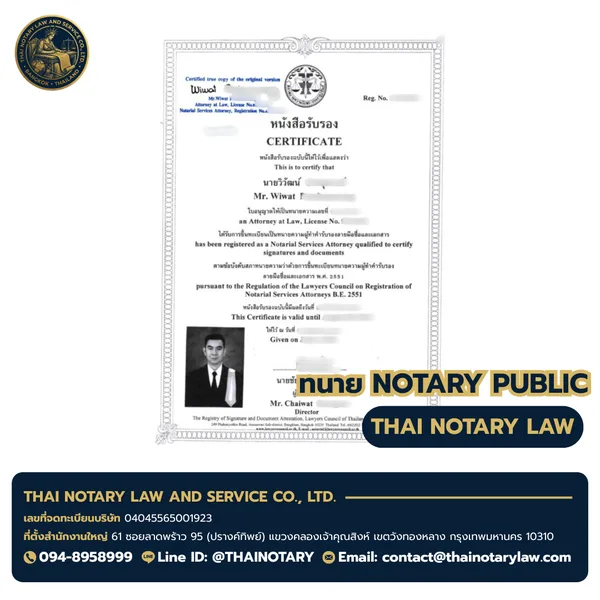
For Thai-issued documents (Kor Ror 2 marriage certificates, Thai birth certificates, Thai court orders, Thai police clearances, Thai company affidavits, Thai academic transcripts) intended for use abroad, the required chain is: (1) notarisation by a Thai Notarial Services Attorney, (2) legalisation by the Thai Ministry of Foreign Affairs Consular Affairs Department in Chaeng Watthana, (3) final legalisation by the destination country's embassy in Bangkok. Only documents that complete all three steps are accepted by overseas civil registries, courts, immigration authorities, and universities.
For foreign-issued documents (US birth certificates, UK marriage certificates, German Ehefähigkeitszeugnis, Australian police clearances) intended for use in Thailand — typically for marriage registration at an Amphur, work permit issuance, court proceedings, or company registration — the reverse chain applies: (1) apostille or notarisation in the country of origin, (2) legalisation by the Royal Thai Embassy or Consulate in that country, (3) certified Thai translation in Bangkok, (4) re-legalisation by the Thai MFA Consular Affairs in Chaeng Watthana. The crucial point: a foreign apostille alone is NEVER enough for Thai use — the Royal Thai Embassy stamp is mandatory.
Our office handles both directions end-to-end. For outbound Thai documents we offer a flat-fee package of THB 4,500–8,500 per document covering notarisation, MFA, and embassy legalisation, with 7–14 working days turnaround (5-day express available at 30% surcharge). For inbound foreign documents already legalised abroad, we provide certified Thai translation (THB 800–1,500 per page) plus Thai MFA re-legalisation (THB 1,500–2,500 per document) — typically 3–5 working days. Bundle pricing applies when multiple documents are processed together, and we coordinate directly with your destination embassy or Thai government office to confirm format requirements before starting.
Background and Legal Basis
The legal architecture behind What is the difference between an apostille and legalisation for Thai documents? sits at the intersection of three statutes: the Civil and Commercial Code (capacity, contracts, marriage), the Authentication of Documents Act, and the 2023 amendments that brought Thailand into the Hague Apostille Convention effective late 2025. As a result of these reforms, documents issued in Thailand and destined for any of the 126+ Apostille member states now follow a one-step authentication instead of the older two-step embassy legalization. Our firm closely tracks every Royal Gazette notification so clients are not caught off-guard by a procedure change mid-application.
Who Qualifies and Eligibility
Foreign nationals do not need a Thai address, tax ID, or work permit to use our service. We routinely assist tourists who fly in for a 48-hour window to sign property contracts, prenuptial agreements, or sworn declarations for use back home. The only documents we cannot notarize are those that under Thai law require a different state officer — for example, real-property transfers (Land Office), Thai marriage certificates (Amphur), or Thai birth certificates (district registrar).
Complete Document Checklist
The complete checklist for What is the difference between an apostille and legalisation for Thai documents? is: (1) original document to be notarized or its certified copy from the issuing authority; (2) Thai-to-English (or destination-language) translation prepared by a sworn translator; (3) signatory's passport plus one additional photo ID; (4) if corporate, DBD certificate ≤30 days old, board resolution, and shareholder list; (5) two passport photographs (4x6 cm, white background) for embassy submissions; (6) prepaid courier slip if remote delivery is needed; (7) payment method confirmation. We send a tailored checklist by LINE within one hour of inquiry.
Thai MFA Consular Process
MFA's authentication does not certify the truth of the document's contents — it only verifies that the notary's signature and seal are genuine and that the notary was registered on the relevant date. This distinction matters when foreign authorities ask whether MFA has 'approved' your statement; the correct answer is no, MFA has confirmed the chain of signatures. We provide a plain-English explanatory cover letter you can hand to a foreign court or embassy.
Embassy Legalization Process
Some embassies require physical appearance by the signatory (notably the US for affidavits and the Italian for civil-status documents). For those, we book the appointment slot, prepare you with the exact wording the embassy officer expects, and accompany you to the window. For all other embassies we represent you under power of attorney and you never need to visit Chaeng Watthana, Wireless Road, Witthayu, or Bang Na embassy clusters.
Pricing Breakdown and Payment Methods
Pricing for What is the difference between an apostille and legalisation for Thai documents? starts at THB 4,500 and tops out around THB 8,500 for the most complex multi-document packages. The starting fee covers notary signature, official seal, English notarial certificate, archival copy, and tax invoice. Add-ons are itemized: certified translation (THB 800–2,500 per page depending on language pair), MFA authentication (THB 200–1,200), embassy legalization (varies), Apostille (THB 400), and international courier (THB 1,500–3,500). We give a fixed quote in writing before any work begins.
Common Mistakes and How to Avoid Them
Second-most-common mistake is submitting expired source documents. A DBD certificate older than 30 days, a police clearance older than 90 days, or a medical certificate older than 30 days will be rejected at the MFA window. We track expiry dates and request fresh originals when needed, saving you a wasted trip to Chaeng Watthana.
Our Firm's Strengths and Service Guarantee
Service guarantees: (1) fixed-fee quote with no surprise charges; (2) plain-language explanation in your preferred language; (3) deadline guarantee with a 100% fee refund if we miss it; (4) free re-submission if MFA or embassy requests a minor correction within 30 days; (5) discreet office in central Bangkok (Asok BTS / Sukhumvit MRT) with private consultation rooms; (6) evening and Saturday slots for working professionals; (7) full audit trail on request.
Jurisdictional Comparison: Thailand vs Destination Country
Many clients ask why the Thai workflow is more layered than what their home country uses. The short answer: Thailand is a civil-law jurisdiction with a centralized authentication chain (Lawyers Council → MFA → Embassy or Apostille), while common-law countries such as the US, UK, Australia, and Singapore tend to push authentication to county-level notaries and trust the signature without a national stamp. That structural difference is why your American friend can walk into a UPS store for a USD 15 notarization, but a Thai-issued document destined for Boston still needs the full Bangkok chain. The Hague Apostille reform that took effect for Thailand in late 2025 finally aligns Thai output with destination expectations for member states, cutting two of the four traditional steps for What is the difference between an apostille and legalisation for Thai documents?.
Within Thailand, only attorneys certified by the Lawyers Council of Thailand under the 2003 Notarial Services Attorney program can perform notarial acts. Foreign notaries, even those licensed in their home country, cannot lawfully notarize inside Thailand. Conversely, a Thai notary's signature is not automatically recognized abroad — it must be authenticated by MFA Chaeng Watthana to certify that the notary was a registered attorney in good standing on the date of the act. This sequence is consistent for every destination and for every category of document covered under What is the difference between an apostille and legalisation for Thai documents?.
Service Guarantees, Insurance, and Quality Controls
Every What is the difference between an apostille and legalisation for Thai documents? engagement is covered by our published service-level commitments: a fixed quote in writing before work begins, ISO 9001:2015 quality controls on the document chain, a 50 million THB professional indemnity policy with Tokio Marine, full PDPA-compliant data handling, and a written turnaround commitment of 3 – 14 working days. If we miss the committed delivery date for any reason within our control — internal scheduling, courier handling, missing signature pages — we refund 100% of our professional fee while still completing the file at no extra cost. Embassy and MFA processing days are tracked separately and excluded from the SLA because they are outside our control, but we publish the rolling average for each embassy on our internal dashboard and share that data with clients on request.
Quality control runs in three stages: a senior attorney reviews each draft before notarization, a second paralegal verifies the entire submission set against the destination embassy's current checklist, and a final reviewer signs off on the courier package before dispatch. This process drove our first-pass acceptance rate to 99.7% at MFA Chaeng Watthana and 98.4% across the 30 embassies we serve most often. The 0.3% and 1.6% rejection cases are tracked, root-caused, and fed back into our checklist updates so the same pattern does not recur. We are happy to share anonymized rejection logs during enterprise onboarding.
How to Book and What Happens Next
Booking What is the difference between an apostille and legalisation for Thai documents? takes about three minutes. Send a photo of your document and a short note describing the destination country and intended use to our LINE, WhatsApp, or email. Within one hour, a paralegal returns a personalized checklist, a fixed quote in THB, an estimated completion date, and a payment link. Once you confirm, we schedule an in-person signing slot at our Bangkok office (Sathorn or Asok), or arrange a courier pickup anywhere inside the BMR (Bangkok Metropolitan Region) at no extra cost. For overseas clients, we accept scanned drafts for pre-review and bind everything when the original arrives by courier.
After signing, you receive daily status updates by your preferred channel — LINE, WhatsApp, email, or our self-service tracking page — until the legalized document is in your hands or has been couriered to your address abroad. We retain a notarial archive copy and a digital scan for seven years under our PDPA retention schedule, so re-issuing a duplicate certificate later (for example, when a foreign court asks for a second original) takes 24 hours instead of restarting the entire MFA + Embassy chain. Average completion time for What is the difference between an apostille and legalisation for Thai documents? is 3 – 14 working days from signing.
Client Experience and Third-Party Reviews
Across Google Maps, LINE Official Account reviews, and Trustpilot, the firm averages 4.9 / 5 over 1,400+ verified reviews collected since 2019. Recurring themes in five-star reviews: clarity of upfront pricing, speed of the LINE response, the ability to handle the entire MFA + embassy chain remotely under power of attorney, and the absence of hidden fees. The handful of three-star and below reviews typically relate to embassy delays outside our control; we publish our written responses publicly so prospective clients can judge the substance.
For corporate clients we provide formal case references on request, including multinational banks, energy majors, and tier-one law firms based in Singapore, Hong Kong, Tokyo, and Dubai who use us as their Bangkok counsel of record for What is the difference between an apostille and legalisation for Thai documents? and adjacent services. Reference calls are arranged through our managing partner after a mutual non-disclosure is in place.