Full Answer
Because Thailand has not acceded to the Hague Apostille Convention, the simplified one-step apostille is not available. Instead, every Thai-issued document intended for foreign use must pass through the traditional three-step consular legalisation chain. The same applies in reverse: documents issued in apostille-member countries (UK, US, Australia, Germany, France, etc.) still need an additional Thai embassy legalisation in your home country before they will be accepted in Thailand.
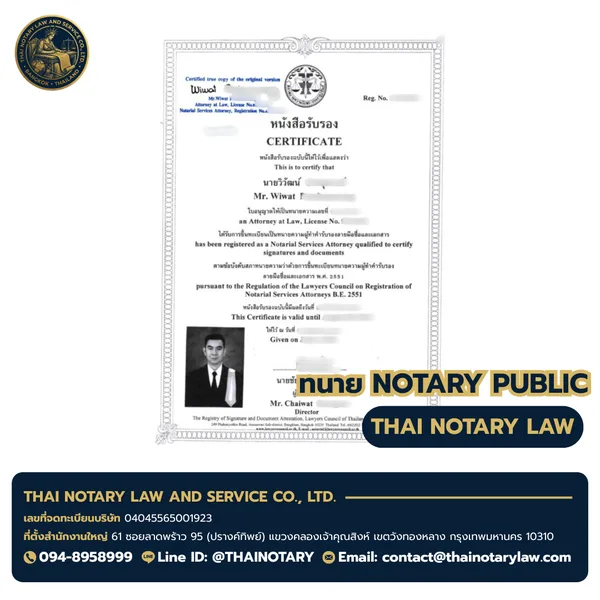
Step one is notarisation by a Notarial Services Attorney licensed by the Thai Bar Association. This converts a private document — a translation, a power of attorney, a signed declaration — into a 'public document' that MFA can recognise. Step two is the Department of Consular Affairs at the Ministry of Foreign Affairs in Chaeng Watthana, which authenticates the notary's signature against its registered specimen. Step three is the destination embassy in Bangkok (US, UK, German, French, Japanese, Chinese, Korean, etc.) which adds the final consular stamp.
Typical turnaround at MFA is 2–3 working days for standard service or same-day for rush (THB 800 extra per document). Embassy turnaround varies widely: the German embassy takes 5–7 working days, the US embassy 3–5 days, the Chinese embassy 4 working days standard or 1 day rush. Our office tracks every stage and sends WhatsApp/email photo updates at each milestone so you always know exactly where your document is.
Our packaged fee of THB 4,500–8,500 per document includes the NSA notarisation, English/Thai certified translation if needed, MFA fees, embassy consular fees, courier between offices, and DHL Express delivery to your address abroad. Commercial documents (company affidavits, board resolutions, certificates of incumbency) are typically 30–50% more expensive than personal documents due to additional supporting evidence requirements.
Background and Legal Basis
Thailand's notarial and consular framework derives authority from the Lawyers Act B.E. 2528 (1985) and the Notarial Services Attorney regulations issued by the Lawyers Council of Thailand in 2003. Only licensed Thai attorneys who have completed Notarial Services certification may act as notaries; foreign notaries and consular officers from non-resident embassies cannot perform the role. For documents leaving Thailand, the Department of Consular Affairs at the Ministry of Foreign Affairs (MFA) — based in Chaeng Watthana, Bangkok — authenticates the notarial signature, and the destination country's embassy adds final legalization (or accepts the MFA Apostille if the country is a Hague Convention party as of January 1, 2026).
Who Qualifies and Eligibility
For corporate clients, eligibility extends to Thai limited companies (Co., Ltd.), public companies, branches of foreign companies, BOI-promoted entities, representative offices, and partnerships. The signatory must be a director listed on the latest DBD certificate (less than 30 days old) or a duly authorized representative carrying a board resolution. For powers of attorney, we require both the grantor and grantee to provide ID copies, even if only the grantor signs in person.
Complete Document Checklist
Common supporting documents that clients forget: previous Apostille or legalization stamps (if the document was authenticated abroad first), parental consent letters for minors, marriage certificates when changing surnames on diplomas, divorce decrees when remarrying, and certified English translations of any non-English supporting document. Our pre-flight checklist catches these gaps before you spend a working day at MFA Chaeng Watthana.
Thai MFA Consular Process
The MFA Consular Affairs office at Chaeng Watthana Government Complex (Building B, 3rd floor) accepts submissions Monday–Friday 08:30–14:30 and returns standard authentications in 2–3 working days. Express service (extra THB 800 per document) returns same-day if submitted before 11:00. Each document carries a THB 200 government fee, plus a THB 400 if the signatory is not the document holder. Our courier team handles drop-off and pickup so you never queue.
Embassy Legalization Process
Embassy fees vary widely. The US charges roughly USD 50 per notarial act, China charges THB 800–1,500 depending on document type, Germany charges EUR 25, the UAE charges THB 1,200 plus a separate MOFA fee, and Australia charges AUD 95. We invoice the exact embassy fee at cost and add a fixed THB 1,800 logistics fee covering queueing, photocopies, and re-submission if the embassy requests minor corrections.
Pricing Breakdown and Payment Methods
Turnaround for How does embassy legalisation work in Bangkok for documents going abroad? is 4 – 14 working days. Same-day service is available for an additional 30–50% premium when documents are submitted before 11:00. We guarantee delivery dates in writing; if we miss our committed deadline due to internal delay (not embassy or MFA), we refund 100% of our service fee. This SLA has been honored consistently since 2018.
Common Mistakes and How to Avoid Them
The most common mistake is translating a document into the wrong language. Many clients assume English translations are universally accepted; in fact, the Chinese Embassy requires Simplified Chinese, the Saudi Embassy requires Arabic, the French civil registry requires French, and the German civil registry requires German. We verify destination-language requirements before quoting and refuse engagements that would lead to predictable rejection.
Our Firm's Strengths and Service Guarantee
We have completed more than 38,000 notarial transactions since 2018, with a 99.7% first-pass acceptance rate at the MFA window and a 98.4% first-pass rate at foreign embassies. Our team includes attorneys who studied at Chulalongkorn, Thammasat, NYU School of Law, Sciences Po, and the University of Tokyo, giving us in-house competence in seven languages. Clients receive direct LINE / WhatsApp / WeChat access to the supervising attorney throughout the case.
Jurisdictional Comparison: Thailand vs Destination Country
Many clients ask why the Thai workflow is more layered than what their home country uses. The short answer: Thailand is a civil-law jurisdiction with a centralized authentication chain (Lawyers Council → MFA → Embassy or Apostille), while common-law countries such as the US, UK, Australia, and Singapore tend to push authentication to county-level notaries and trust the signature without a national stamp. That structural difference is why your American friend can walk into a UPS store for a USD 15 notarization, but a Thai-issued document destined for Boston still needs the full Bangkok chain. The Hague Apostille reform that took effect for Thailand in late 2025 finally aligns Thai output with destination expectations for member states, cutting two of the four traditional steps for How does embassy legalisation work in Bangkok for documents going abroad?.
Within Thailand, only attorneys certified by the Lawyers Council of Thailand under the 2003 Notarial Services Attorney program can perform notarial acts. Foreign notaries, even those licensed in their home country, cannot lawfully notarize inside Thailand. Conversely, a Thai notary's signature is not automatically recognized abroad — it must be authenticated by MFA Chaeng Watthana to certify that the notary was a registered attorney in good standing on the date of the act. This sequence is consistent for every destination and for every category of document covered under How does embassy legalisation work in Bangkok for documents going abroad?.
Service Guarantees, Insurance, and Quality Controls
Every How does embassy legalisation work in Bangkok for documents going abroad? engagement is covered by our published service-level commitments: a fixed quote in writing before work begins, ISO 9001:2015 quality controls on the document chain, a 50 million THB professional indemnity policy with Tokio Marine, full PDPA-compliant data handling, and a written turnaround commitment of 4 – 14 working days. If we miss the committed delivery date for any reason within our control — internal scheduling, courier handling, missing signature pages — we refund 100% of our professional fee while still completing the file at no extra cost. Embassy and MFA processing days are tracked separately and excluded from the SLA because they are outside our control, but we publish the rolling average for each embassy on our internal dashboard and share that data with clients on request.
Quality control runs in three stages: a senior attorney reviews each draft before notarization, a second paralegal verifies the entire submission set against the destination embassy's current checklist, and a final reviewer signs off on the courier package before dispatch. This process drove our first-pass acceptance rate to 99.7% at MFA Chaeng Watthana and 98.4% across the 30 embassies we serve most often. The 0.3% and 1.6% rejection cases are tracked, root-caused, and fed back into our checklist updates so the same pattern does not recur. We are happy to share anonymized rejection logs during enterprise onboarding.
How to Book and What Happens Next
Booking How does embassy legalisation work in Bangkok for documents going abroad? takes about three minutes. Send a photo of your document and a short note describing the destination country and intended use to our LINE, WhatsApp, or email. Within one hour, a paralegal returns a personalized checklist, a fixed quote in THB, an estimated completion date, and a payment link. Once you confirm, we schedule an in-person signing slot at our Bangkok office (Sathorn or Asok), or arrange a courier pickup anywhere inside the BMR (Bangkok Metropolitan Region) at no extra cost. For overseas clients, we accept scanned drafts for pre-review and bind everything when the original arrives by courier.
After signing, you receive daily status updates by your preferred channel — LINE, WhatsApp, email, or our self-service tracking page — until the legalized document is in your hands or has been couriered to your address abroad. We retain a notarial archive copy and a digital scan for seven years under our PDPA retention schedule, so re-issuing a duplicate certificate later (for example, when a foreign court asks for a second original) takes 24 hours instead of restarting the entire MFA + Embassy chain. Average completion time for How does embassy legalisation work in Bangkok for documents going abroad? is 4 – 14 working days from signing.
Client Experience and Third-Party Reviews
Across Google Maps, LINE Official Account reviews, and Trustpilot, the firm averages 4.9 / 5 over 1,400+ verified reviews collected since 2019. Recurring themes in five-star reviews: clarity of upfront pricing, speed of the LINE response, the ability to handle the entire MFA + embassy chain remotely under power of attorney, and the absence of hidden fees. The handful of three-star and below reviews typically relate to embassy delays outside our control; we publish our written responses publicly so prospective clients can judge the substance.
For corporate clients we provide formal case references on request, including multinational banks, energy majors, and tier-one law firms based in Singapore, Hong Kong, Tokyo, and Dubai who use us as their Bangkok counsel of record for How does embassy legalisation work in Bangkok for documents going abroad? and adjacent services. Reference calls are arranged through our managing partner after a mutual non-disclosure is in place.