The Thai visa categories most relevant to expats in 2026
(1) Non-Immigrant B (Business/Work) — single-entry 90 days from Thai embassy abroad; multiple-entry 1-year for executives; converts to a Bangkok extension once work permit is issued. (2) Non-Immigrant O for retirement — for applicants 50+ with either THB 800,000 in a Thai bank or THB 65,000/month income; converts to 1-year retirement extension at Immigration. (3) Non-Immigrant O for Thai-spouse marriage — for non-Thai spouses of Thai citizens with marriage certificate Kor Ror 3 + financial proof of THB 400,000 in a Thai bank or THB 40,000/month income. (4) Non-Immigrant ED — student visa, requires acceptance letter from a Thai educational institution registered with the Ministry of Education. (5) Long-Term Resident (LTR) visa — 10-year multiple-entry for wealthy global citizens, wealthy pensioners, work-from-Thailand professionals, and highly skilled experts under BOI administration. (6) Destination Thailand Visa (DTV) — 5-year multiple-entry workcation visa for digital nomads, sport-training participants and Thai-soft-power category applicants. (7) SMART Visa — bundled with work permit for tech experts/executives/investors/startups in 13 priority industries. (8) Tourist visa (TR60) — 60-day single-entry extendable by 30 days at Immigration. (9) Visa-exempt entry (30 days for 64+ nationalities) — not a visa, but a visa-free admission; cannot be used for work and has stricter overstay penalties.
Application-side documents and the legalization chain
- Passport — minimum 6 months validity at the date of application; 18 months recommended for 1-year extensions because Immigration sometimes requires the extension's end date to fall within the passport's validity.
- Photos — 4 × 6 cm or 35 × 45 mm, white background, taken within 6 months, head and shoulders, no glasses, no head covering (religious exceptions accepted with explanation letter).
- Financial proof — Thai bank statement issued by the bank's head office (not branch), original signed and stamped, dated within 7 days of filing; some Immigration offices accept e-Statement with bank verification letter.
- Marriage certificate (for spouse-O) — must be Thai Kor Ror 3, or if married abroad: original foreign certificate + apostille/legalization + Thai translation + MFA certification.
- Degree certificate (for B and ED) — original + apostille/legalization + Thai translation; for online or distance degrees, additionally the Office of the Higher Education Commission may require equivalency assessment.
- Police Clearance Certificate from country of nationality — required for LTR and certain sensitive sector employment; should be apostilled and translated.
When you can apply in Thailand vs at a Thai embassy abroad
Initial application — most non-immigrant categories (B, O, ED, IM) must be applied for at a Thai embassy abroad before entering Thailand; exceptions include conversion-in-Thailand for tourists who meet retirement or spouse requirements (allowed at Bangkok Immigration with TM86 and supporting documents) and conversion for clients holding work permits issued under emergency 15-day permits. Extension — once in Thailand on a non-immigrant visa, the 1-year extension is applied for at Immigration; the extension is separate from the visa itself and is recorded as a stamp 'permission to stay until [date]'. Re-entry — to leave and return on the same extension, a re-entry permit (single ฿1,000 or multiple ฿3,800) must be obtained before departure, otherwise the extension lapses on exit. Visa-on-Arrival (VoA) — available for 19 nationalities for 15-day stays, requires return ticket and ฿10,000 cash showable on demand; not suitable for any stay over 15 days.
Common Immigration-officer-discretion friction points
- TM30 host-notification mismatch — landlord or hotel must file Form TM30 within 24 hours of any foreign guest's stay; Immigration cross-checks TM30 against your visa file and a missing TM30 leads to a ฿1,600–฿2,000 fine and possible extension refusal.
- Bank balance fluctuation — for retirement extensions, the THB 800,000 must sit in the account for 60 days continuously, then 3 months thereafter the balance must not drop below THB 400,000; mid-year withdrawals trigger renewal denial.
- Address mismatch on TM6 vs lease — the address you wrote on your TM6 arrival card must match your current registered address with Immigration; address changes require a 24-hour TM28 filing.
- Photographic discrepancy — Immigration sometimes rejects photos taken within 6 months but with significantly changed appearance (new beard, dyed hair); bring spare fresh photos to every filing.
- Hand-written corrections on forms — Bangkok Immigration accepts strike-through with initial, but provincial offices increasingly require a clean reprint; bring a second blank form as backup.
Our document-side service for visa applicants
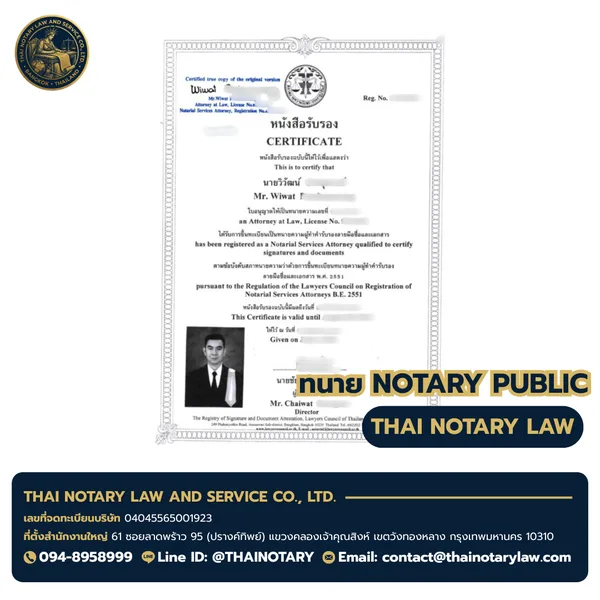
We do not file Immigration applications directly (only Immigration-registered visa agents may do that), but we provide the document chain that 90% of visa rejections trace back to: (1) Legalizing foreign-issued degrees, marriage and birth certificates through the apostille / Thai-embassy-abroad chain and producing certified Thai translations acceptable to Immigration. (2) Drafting affidavits of support for visa sponsors and notarizing them with our Notarial Services Attorney signature on file with embassies and Immigration. (3) Notarizing Powers of Attorney for clients who must leave Thailand mid-process and grant a Thai-resident representative authority to submit, collect or amend the file. (4) Producing certified translations of foreign tax returns, employment letters and financial proofs used in LTR and BOI-track applications. (5) Coordinating with your visa agent or BOI-registered immigration counsel so the document chain matches the filing checklist exactly. Our average document-chain turnaround is 4–7 working days for in-Thailand legalization and 12–20 working days when an apostille step must run abroad first.